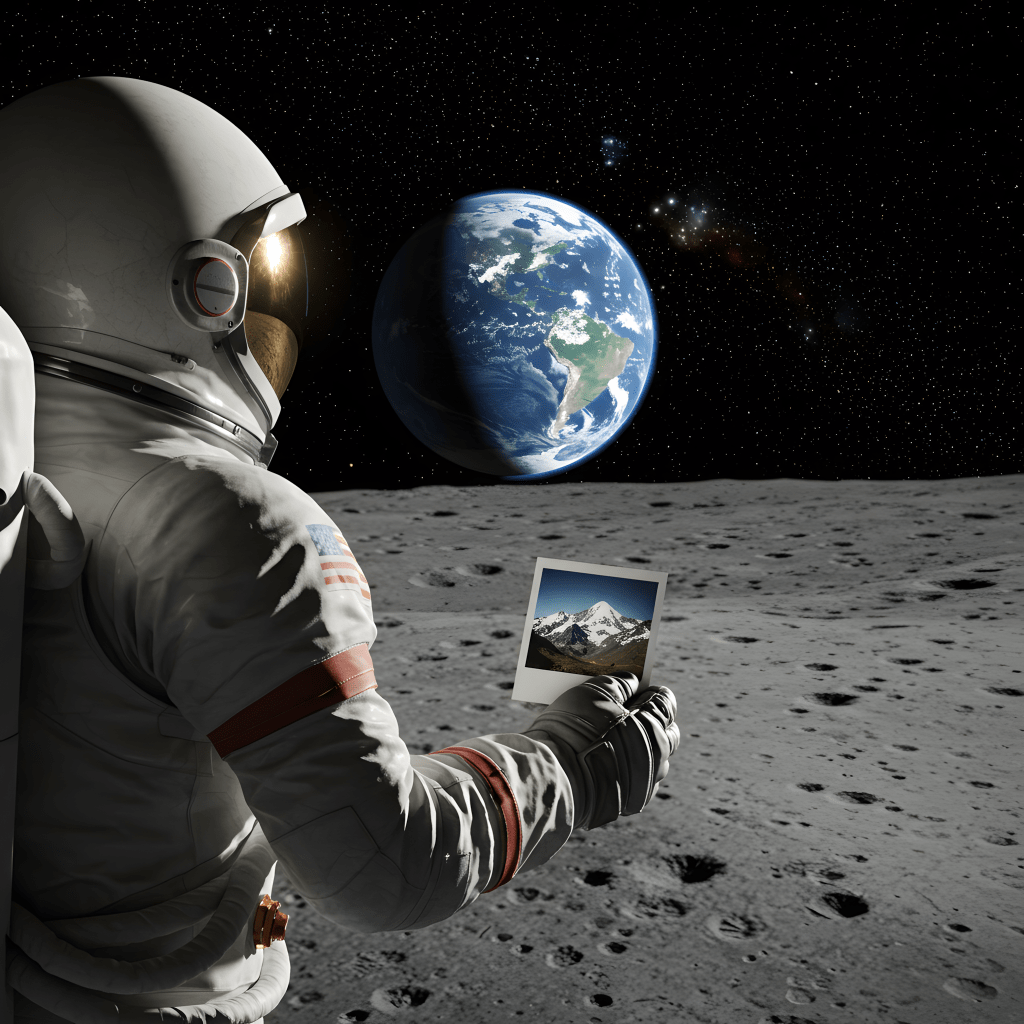
Mountains are a LOT bigger than the moon.

That’s certainly what my toddler thinks.
Standing on my back patio, watching the rising sun light up the beautiful, snow-covered 14er that stands only a few miles to the west, I’m in awe. It’s truly an amazing sight, and much easier to wrap your mind around than something like the moon.
And just to be clear, I love mountains. I really really do.
BUT, the more time I spend thinking about the moon, the more it holds the very deepest of my curiosities and my fascination.
I don’t think you need to be an astrophysicist or an astronaut to really appreciate the moon. But I do think there is one scientific exercise that serves to increase the curiosity and awe substantially, and that is expending the mental energy to try to comprehend the following:
The moon is SO much farther away from the Earth than most people think.
Something about the way we interpret size and scale at that distance really distorts our understanding of the moon. On average, the moon is about 240,000 miles away from the Earth. That’s a pretty big number compared to the 6 – 7 mile cruising altitude of a common passenger airplane, or the 5.5 mile high peak of Mount Everest. But I don’t think we can really comprehend that difference just by looking at the numbers. The other piece that I believe most people underestimate is the size. When you look up at the moon in the sky, your brain attempts to understand how large it is and how far away it is. But I think it misses the mark. I would argue that most people think the moon is smaller and closer to Earth than it is.
I believe the roughly to-scale image below accomplishes the important first step of challenging our current understanding of how far away the moon really is. Please take a few seconds to just look at this image and try to believe it; it’s accurate.
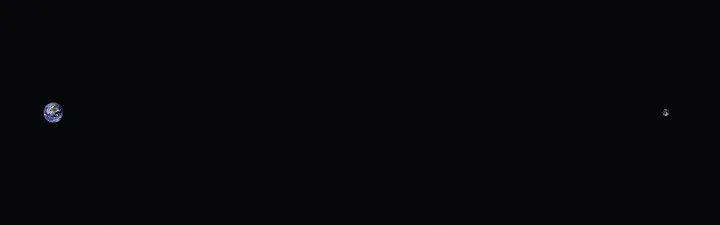
NOW. If the image above is accurate (it is), then the moon is much farther away than we’re thinking when we look up at it. And if it’s much farther away, then it is also much BIGGER than we’re imagining.
It’s at about this point that my wife would say something like “honey, I love that you’re excited about this, but my listen to Josh talk about sciencey space stuff tank is pretty much empty. What’s the point of all this?”
I’m glad you asked 🙂
Today is National Space Day. A day to celebrate the achievements we’ve made in space exploration and primarily to inspire and motivate students.
I believe the very first step on an intellectual and career journey in the direction of space and other STEM fields is fascination. Only through fascination and awe do we generate passion, and only through passion do we understand what makes science, technology, and space so incredible and important.
When I was young, I would glance briefly at the moon and then go about the rest of my day. But these days, when I see the moon, my eyes linger. I PLACE the attention of my mind and my heart on this difficult-to-comprehend celestial body. I make myself remember that there actually is this giant spherical rock nearly as wide as the United States, MUCH farther away than I naturally think, and that human beings have flown hundreds of thousands of miles to it and stood on its surface, looking back at our big blue planet. And each time I contemplate its existence, its scale, my fascination grows just a little bit. And with it my curiosity. And IN THAT, my excitement and motivation for, and my trust in, the STEM fields is formed and solidified.
So today…
Tonight…
Look at the moon.
And keep looking.
If you’ve made it this far, thanks for reading!
Let me know what STEM topics capture your fascination 🙂

 Josh Olson
Leave a comment